

We drove past this two weeks ago (i.e. October 2005), and were struck by two things:
- The last time we’d seen the corner, they hadn’t even broken ground on anything.
- Opening April 2005?

We drove past this two weeks ago (i.e. October 2005), and were struck by two things:
I was idly wondering about the way super-heroes and villains are named—not the code names, but the actual names like Clark Kent, Matt Murdock, etc. Was Hunter Zolomon destined to become Zoom? Was Roy G. Bivolo doomed to become the Rainbow Raider the moment his parents named him? And why do so many people with the initials L.L. gravitate toward Superman?
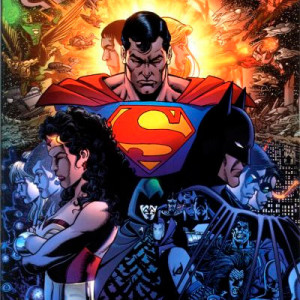 “Obviously, he’s a ta’veren!” Katie said. I laughed for a second, but then remembered an interview I’d read about Infinite Crisis. It actually fits.
Ta’veren is a term from Robert Jordan’s The Wheel of Time that refers to a person who forms a focal point for history (or, from another perspective, destiny). Threads of probability bend around them, and the unlikely becomes likely. Babylon 5 referred to the concept as a nexus. “You turn one way, and the whole world has a tendency to go the same way.” Continue reading
Neil Gaiman writes that Amazon lists 2025 as the release date for the MirrorMask DVD.
Twenty years seems a long way away, but Sony are probably just scheduling it that far off because during the Great iPod Content Uprising Years of 2013-2024 people aren’t going to have much time for things like actually watching films, what with gathering together in places where the iPodPeople can’t get them and shooting them in the brain and all that stuff, and it’s only after the Man-Droid-iPod Peace Treaties of 2024 that anyone gets back to the serious business bringing out DVDs of long-forgotten movies.
“Alternately,” he adds, “I suppose it could be an Amazon.com typo and MirrorMask could be coming out on the last day of this year. That would be nice.”
Over the weekend, Something Positive’s Monette met her girlfriend’s half-brother, who wants to write showtunes when he grows up. Friday’s Real Life featured Tony taking Greg to task over singing a song from Monty Python’s Spamalot. Where did the showtunes=gay (or at least effeminate) stereotype come from? While we’re at it, where did the art=gay stereotype come from?
I mean, most of the people who actually write musicals are probably straight. Not all of them, of course, and some of the exceptions (Cole Porter, for instance) are rather prominent. And I would guess that a majority of the actors and audience are probably straight, also.
I have no doubt that the percentage of gays in the arts is higher than in the general population. I studied drama in college—all I had to do was look around to see that. But that’s a far cry from “most.” I mean, to pull some numbers out of thin air, let’s say it’s 20%, or even 30%, instead of the commonly-cited 10%—that would be like saying an industry with 30% women is primarily female. Continue reading
You know, somehow I wasn’t convinced we’d actually run out of hurricane names this year, even though it looked possible. But the National Hurricane Center has just named tropical storm depression Alpha, marking the first time more than 21 tropical storms have been recorded in the Atlantic in one year.
Just got an email from Disney on Broadway (I assume I must have given them my email address when I bought Lion King tickets several years ago) offering me advance tickets to their new Broadway show, Tarzan.
WTF?
Admittedly, I thought The Lion King was an odd choice for a stage musical, and it turned out to be quite good. But Tarzan? I mean, it’s a weird enough choice for a musical in the first place, but Disney’s cartoon wasn’t even really a musical—it was a movie with a Phil Collins soundtrack.
I wish I could remember exactly what Aimee Mann said last week when she introduced “Save Me.” It was something like “Yes, this is the song that lost the Oscar to Phil Collins and his cartoon monkeys monkey love song.” (Katie remembered it.) Apparently she says this regularly.
Bleah. I’d rather they put together a new tour of Beauty and the Beast. With any luck it’ll still be playing when we finally get around to visiting New York. (I honestly didn’t know it was still playing now until I went to look at the Tarzan info.)
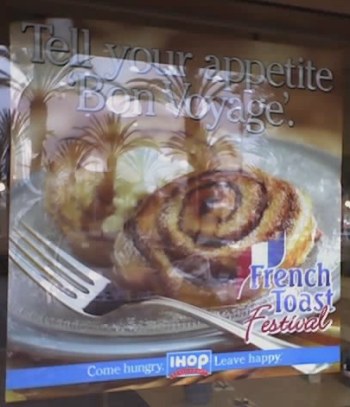
One look at this, and you’ll say goodbye to your appetite! Wait, I’m sure that’s not what they’re going for…
(On another level, the reflected palm trees fit in with the travel theme.)