DC Comics recently canceled its Minx line of graphic novels aimed at teen girls, leading to much discussion amongst comics bloggers. I don’t want to talk about why the line folded, but why the line existed in the first place. Why did DC create an entirely new brand in order to go after this audience?

A big advantage to creating a new label: no preconceptions. Prospective readers won’t look at the cover, see a DC logo, and wonder where the super-heroes show up and rip off people’s arms. And they won’t see a Vertigo logo and assume that it’s a “mature readers” book. On the downside, a new label has to build its credibility from the ground up, instead of starting with name recognition.

This got me thinking: an established brand associated with customers of one gender creates a new brand in order to target the other half of the population. Where else have I seen this?

I own a jacket labeled Claiborne, which is of course made by the Liz Claiborne company.

Mervyns sells (or used to) H&H Men clothing, which was clearly a variation on their Hillard and Hanson brand.

All the examples I could think of (other than Minx itself) were companies that had traditionally been aimed at women, but were adding lines aimed at men. It made me wonder: is it the names? Do men feel odd buying a product named “Liz,” while women are used to buying brands named after both men and women? (Sara Lee notwithstanding.) Maybe it’s the stigma of a man participating in something perceived as feminine? Sort of like the assumption in children’s TV that boys will only watch shows about boys, while girls will watch shows about girls or boys (so they make shows about boys instead of girls, figuring they’ll get a bigger audience).

Then Katie pointed out LEGO Belville, the line aimed at girls which entirely misses the point of LEGO by making as much of each set prefab as possible. And pink. On the plus side, unlike Claiborne, Belville doesn’t try to hide the fact that it’s a LEGO product.
That makes it more like Men’s Vogue, a copy of which is sitting in the lunch room at work. In this case they’d have to call it something different (unlike a clothing line) because it’s not just a brand, but the title of the magazine.

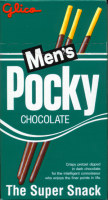
I still think the craziest example of this has to be Men’s Pocky. It’s a cookie. One which I’d hardly consider a “girlie” cookie, but maybe it’s more associated with girls in Japan. I still can’t figure out whether it’s a case of cultural translation or deliberate absurdity.

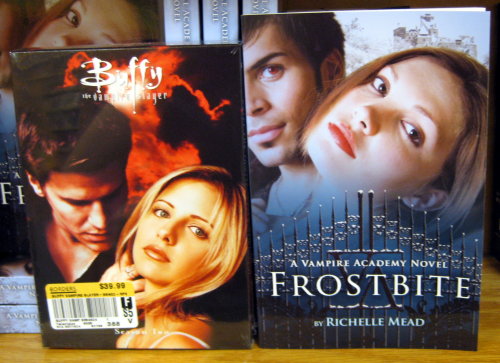
Looking at the “all ages” shelf in Borders, which seems to be almost entirely made up of novels about vampires and dragons, I noticed that the cover to the Vampire Academy novel Frostbite looked awfully familiar. I walked over to the DVD section of the store and picked up a copy of Buffy the Vampire Slayer, Season 2.

This may be the most recognized image from Buffy the Vampire Slayer, and I just could not believe that the cover designer would copy the layout so closely.

Somehow, we’ve found ourselves watching a lot of shows on Fox this fall. And two out of three are returning, so we can be confident that they’ll actually finish out the season. The third is Fringe, and I’m still trying to decide whether I want to keep up with it.

So far it basically seems to be The X-Files as done by J.J. Abrams, with a corporate conspiracy replacing the government conspiracy. Which is fine, except I wasn’t particularly interested in The X-Files. I think I saw about 5 episodes plus the first movie.

One thing I’m not thrilled about is the implication that everything they investigate is going to be part of “The Pattern.” It seems awfully convenient that all the weirdness stems from one lab’s experiments back in the 1970s, with (presumably) one partner causing and the other investigating the weirdness. I’d actually prefer it if they sometimes ran into things that were weird and bizarre, but came from other people’s work.

They also seem to be big on body horror, which is not my favorite topic to watch on a weekly basis. Though that could just be the first two episodes.

The most interesting character so far is the mad scientist Dr. Bishop, played by John Noble. Oddly enough, I didn’t recognize the actor until the second episode.

The pilot episode actually got to a point about 2/3 of the way through where I wanted it to end. I found myself thinking, “Okay, the story’s done, you can wrap up the episode now.” Kind of like The Talented Mr. Ripley, it just kept going. Still, it was a pilot, and it was trying to do setup, so they get a pass.

Something I’ve noticed is that it’s easier for me to suspend my disbelief on things that are completely and totally “out there” than things that are just a little bit past normal. For instance, to bring up some spoilers from episode 2: Continue reading

It seems that Old Navy is branching out into adoption services:


“Hey, what a deal! At that price, you wanna get two?”

Of course some people go the traditional route to save money.

Sometimes, though, you just have to wonder what’s going through someone’s head when they come up with a brand name. 😯

So is Jonathan Swift the CEO?

I was looking at Slashdot this morning and found a link to the article on the original iPod launch back in 2001:

“At an invitation only event Apple has released their new MP3 player called the iPod. iPod is the size of a deck of cards. 2.4″ wide by 4″ tall by .78″ thick 6.5 ounces. 5 GB HDD, 10 hr battery life, charged via FireWire. Works as a firewire drive as well. Works in conjunctions with iTunes 2. Here are Live updates”

No wireless. Less space than a nomad. Lame.

It’s funny to see all the comments about how it’s a worthless unmarketable product that no one will buy and represents the point at which Apple will finally slide into irrelevance…when what really happened was that the iPod became the leading digital music player (“iPod” is practically a synonym for “portable digital music player” today, in the way “Walkman” was a synonym for “portable cassette player” back in the 1980s). As Apple’s best-selling product line, it made it possible for them to open retail stores and move into new markets. I’d bet the iPhone wouldn’t exist without the iPod’s success. And of course there’s the iTunes music store leading the digital music market itself.

Re-watched some classic cartoons yesterday.  It started when we were talking about Duck Dodgers at breakfast, and wondered when it had been made.  That led to an IMDB lookup, which mentioned it was #4 on a list of 50 Greatest Cartoons of all time from 1994, and that had me looking up “One Froggy Evening” to verify that it was in fact the cartoon with the singing, dancing, Michigan J. Frog… and that had a link to the cartoon on YouTube.  And YouTube brings up a list of related videos at the end of each clip…

By the time we stopped, we’d also watched “What’s Opera, Doc?” “The Rabbit of Seville” — absolute classics — and a couple of World War II propaganda cartoons featuring Daffy Duck and Donald Duck (the latter in a cartoon based on “Der Fuehrer’s Face”).

At the other end of the spectrum, a week ago I watched 2 DVDs worth of 1967 Filmation cartoons starring various DC super-heroes.  I wanted to do a write-up of the Flash, Justice League and Teen Titans cartoons, and figured I might as well watch the whole thing and do a review. They were seriously cheesy. They were played straighter than Super-Friends, but can’t stand up to the Bruce Timm-designed Justice League series.

»All pages site-wide with this tag