Here are some interesting/amusing signs we spotted on our trip to Northern California last month.

Silver Surf MotelSilver Surfer Motel

This seemed appropriate for a trip to a comic convention. And like the Sylar Industries sign I posted earlier, all it needed was a little adjustment. Can you get a room with the power cosmic? Found in San Simeon, across the highway from our motel. (Keep in mind as you read on that the one on the right is the only doctored photo in the post.)

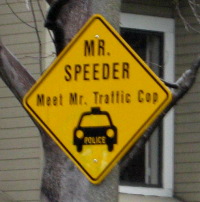
Sign: Mr. Speeder, Meet Mr. Traffic CopMy personal favorite was this one in Sunnyvale. It’s always nice when city planners (or anyone making a sign, really) have a sense of humor.

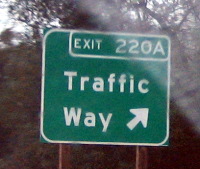
Perhaps Mr. Speeder was frustrated by driving this street, somewhere near San Luis Obispo:

Sign: Exit 220A to Traffic Way
Continue reading

CNET UK presents The 30 dumbest videogame titles ever, including “Spanky’s Quest,” “Ninjabread Man,” “How to Be a Complete Bastard,” “Touch Dic” and “Attack of the Mutant Camels.” (via Slashdot).

Cowboy Bebop at His Computer — examples of media articles (especially about pop culture) in which the reporters (and editors) clearly didn’t do their research. The title comes from a caption on a still from Cowboy Bebop. That’s not the character’s name, and the character in question is female. It probably is her computer, though.

Archeophone Records: Actionable Offenses: Indecent Phonograph Recordings from the 1890s. Comedians telling bawdy stories, recorded on wax cylinders. The write-up is PG, though the track list looks to be at least PG-13. Looked up after reading NY Times’ article on voice recordings from 1860 (recorded with ink on paper), which is also worth a read. (via Slashdot)

Edit: Forgot to list the (temporary) resurrection of 1994-era home.mcom.com, the website of what was then Mosaic Communications Corporation and would soon be renamed Netscape. Subsequently picked up by Boing Boing and Slashdot. For more old web browsers, check out the Browser Archive at evolt.org. (via Justin Mason)

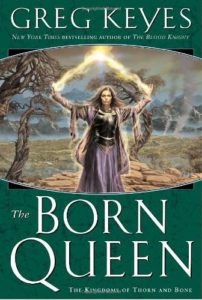
Well, my copy of The Born Queen has arrived via UPS, and I’m nowhere near finished re-reading the first three books of Greg Keyes’ The Kingdoms of Thorn and Bone. I’d hoped to start at the beginning of March, but I was in the middle of the Trade Pact books and wanted to finish that trilogy. Then I figured I could read one book each week like last time and be ready at the point that book 4 arrived…and I promptly got swamped with stuff to do at both work and home, so I found myself reading mainly at lunch (and half the time I ended up eating at my desk instead) and in 20-minute chunks. Now I’ve got the concluding novel, but I only just finished book 1 last night, and I’ve gotten only a handful of chapters into book 2.

I’ve enjoyed re-reading them, though, and while I remembered The Briar King quite well, it’s clear I’ve forgotten enough of books 2 and 3 that it will be well-worth having them fresh in my mind.

Now that I’ve got the final volume here, I think I’ll look for more of those 20-minute chunks of time.

After reading the “Who cares what Earth this takes place on!” intro to the Justice League: New Frontier tie-in comic, I started thinking about the whole Earth-1, Earth-616, etc. thing. The confusion over Earth-1 vs. New Earth in DC (something which overshadowed discussion of the actual story in the first issue of Tangent: Superman’s Reign) highlights the question: just how important is it to label these fictional universes, anyway?

And once you’ve decided to catalog them, how do you label them?

A few multiverses that come to mind are DC’s, Marvel’s, and Michael Moorcock’s.

The multiverse of Moorcock’s Eternal Champion cycle is extremely fluid, with details changing whenever he wants to tell a different story. Just looking at the Elric stories, there are three or four origins for Stormbringer, and as many for the Melnibonéans and their pact with Arioch. There are several versions of the 20th-century Count Ulrich Von Bek (depending on whether you include Count Zodiac). Worlds are less like parallel lines and more like streams that can run together, mingle, and separate again (kind of like the briefly-used Hypertime as used by DC).

DC and Marvel, on the other hand, favor a discrete structure in which each universe can be precisely identified. This may have something to do with the focus on continuity as a key element of comic-book storytelling, and would explain why, for instance, Marvel has made an effort to number what seems to be every single alternate reality they’ve ever published.

Approaches to numbering:

  • Sequential. DC started out like this, with Earth-1, Earth-2, Earth-3, etc.
  • Random. Current DC multiverse, except for the first few we saw at the end of 52 which were based on worlds from the original DC multiverse (Earth-2, Earth-3, Earth-5 from Earth-S, Earth-10 from Earth-X). Marvel’s main continuity, Earth-616, was reportedly picked at random (though there is some disagreement on this point).
  • Referential. Things like choosing Earth-S for the worlds of Shazam or Squadron Supreme, or Earth-C for Captain Carrot. Earth-97 for Tangent (which appeared in 1997) and Earth-96 for Kingdom Come (which appeared in 1996) would also fall into this category (but see the next point).
  • Systematic. Taking referential labels a step further, using a consistent scheme. Marvel derives most of its designations from publication dates.

Personally, I prefer to just name them. “The Tangent Universe” or “New Frontier” or “Supremeverse” gets the idea across more directly than, say, Earth-9.


Up in Napa, we found this sign at the entrance to Syar Industries.

Sign: Syar Industries, Inc.

Being Heroes fans, we couldn’t resist. Not only was the name just one letter off of the show’s popular villain, but the elongated S in the logo was just begging for a trio of crosspieces to turn it into the helix symbol that appears everywhere in the show. A bit of photo-manipulation later:

Adjusted Sign: Sylar Industries, Inc.

Spotted this driving back from LA on Saturday, after Wizard World.

Truck full of tires… changing its tire!

Well, I guess they don’t need to worry about finding the spare!

We both just sort of stared at it for a second or two. Was that really what we thought it was? Then I grabbed for the camera, snapped a shot that didn’t come out well, and handed it to Katie, who had a better view from the passenger seat.

Fortunately the traffic was terrible (now there’s something you don’t say very often) and we were able to get a shot instead of zooming past.

»All pages site-wide with this tag