The kid’s gotten interested in playing music and has been trying out various instruments over the last few months. (Yay for rentals!)

The latest is cello. As soon as he heard Bach’s cello suites, he was convinced.

We lined up lessons with the same teacher he’d had for violin earlier this year. Then we went to a music shop to measure what size he needed and rent a cello.

Only one problem: when we got it home he noticed the bridge was tilted instead of perpendicular to the body of the cello. He can replace a string just fine — he actually had to replace the E string on the rental violin when it snapped during tuning — but we all agreed to wait until his first lesson and let the teacher adjust it. It’s held in place entirely by the tension of the strings, and not something that they recommend beginners mess with.

He had his first lesson a few days later. The first order of business was to adjust the bridge. So she started carefully loosening the strings while holding the bridge until she could shift it into place. And as soon as it moved, we all heard a loud *THUNK* from inside the cello.

“Oh no!” the kid said. “SOUND POST!” And we all looked at each other in sudden horror.

Wait, what’s a sound post?

The sound post is inside the body of the violin or cello, connecting the top and bottom. (Or front and back, I suppose.) I wasn’t sure exactly what it did aside from maybe structural support, but I knew it shouldn’t be rattling around in there, and it was clearly not something that could be fixed on the spot.

And they were both certain that you couldn’t play the instrument without it.

I looked up its acoustic function: the sound post is aligned with one end of the bridge to provide a fulcrum for the bridge to vibrate around. This causes the bridge to transmit the sideways vibrations of the strings (constrained by the bow pressing on them) to vertical vibrations in the body, making it actually sound good. Plucked instruments like guitars don’t need that because the strings can vibrate in all directions.
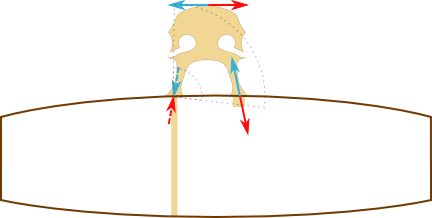
Diagram of the bridge, sound post and body of a violin, showing how the side-to-side motion at the top of the bridge (where the strings pass over it) are transmitted to vertical movements on the body of the violin via rotating around the point where the sound post and one of the bridge supports meet on opposite sides of the top plate of the violin body.
Diagram from leftaroundabout’s answer on Music StackExchange.

So you definitely wouldn’t want that to be missing.

Or rattling around inside the cello.

Plan B

The teacher immediately had to retool the lesson. He couldn’t play the instrument we’d brought. And he couldn’t play her full-size cello. So she introduced him to reading bass clef and some of the basics of how violin and cello differ, and assigned some practice lessons, just in case.

Amazingly, we were able to make it to the music shop in time to swap it for another one that same day. It was half an hour to closing, and could easily take anywhere from 15-45 minutes to get there depending on traffic. And it was a weekday at 5:30. We made it there with 10 minutes to spare!
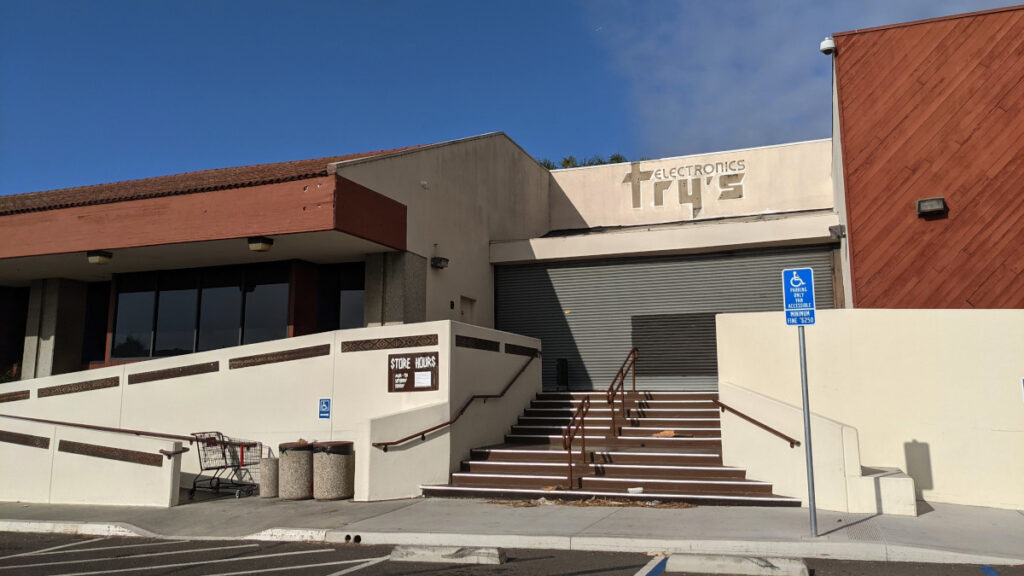
I’m going to miss two things about Fry’s Electronics, which shut down this week:

  • Being able to walk in and grab random parts immediately.
  • The decor.

And yeah, there’s nostalgia for the old days, but they’re already gone.

Back in the 1990s and early 2000s they really were a one-stop shop for computers, software, appliances, all kinds of electronics hardware, and the random snacks you might want to munch on while tinkering or upgrading. You could check out, or better yet try out – they had a huge number of computers available for demos – all kinds of cool tech.

I bought a lot of components for my desktop PC over the years, replacing pieces bit by bit. Sure, you could get complete systems at Micro Center or Best Buy or Circuit City, but none of them had the long tail of components that Fry’s did.

(There was also the generous return policy — I knew a lot of people who used the “Fry’s rental” when they needed something for a single project.)

Service was a mixed bag, though. Sometimes you’d get someone really knowledgeable who could help you pick out the best hardware combination for what you wanted. Sometimes you wouldn’t be able to find anyone. And a lot of the sales staff tended to be proto-techbros, so if you were shopping while female, or looking for Apple products — or worse, both — there was a good chance you’d get someone overly condescending.

Fading Away

They’ve been going downhill for a while. They dropped a lot of the middle range and focused on the high-end and low-end markets. All the articles talk about competition from online stores, and I suspect friendlier brick-and-mortar stores like Best Buy took over a lot of the mid-range consumer market.

When I built a gaming PC a few years ago, I tried Fry’s first, but I couldn’t find most of the parts I wanted. I only bought the case and power supply there, then ordered other parts from NewEgg, Amazon, or direct from the manufacturers. And I went back to Fry’s when I tried to put everything together and discovered I had the wrong mounting rails and needed another case fan.

They never really adapted to online shopping. Their website is still terrible (or was until Wednesday). Before 2019, big deal, I’d just walk into the store and browse anyway. But in 2020, after Covid-19 hit and in-person retail shut down, curbside pickup and shipping were the way to go. The search results were a pain to sort through, even for products that didn’t have nationwide shortages (like webcams). Even when I told it I wanted to look for shipping or local pickup, it kept trying to send me to San Jose, hundreds of miles away.

The Fry’s Experience

Ultimately, though, the most memorable thing about Fry’s couldn’t translate to a website. The locations I’ve been to were all converted warehouses or small office buildings. And each one was decorated with a theme.

Burbank’s store had a flying saucer crashed into the front, with statues of 50’s sci-fi aliens with ray guns scattered around as if they were invading the building. A giant squid’s tentacles supported the computer demo tables.

Anaheim had a giant mock-up of the Space Shuttle. If I remember right, the audio demo room was inside it.

Manhattan Beach had a Pacific Islands theme, with tropical plants, tiki statues, and murals based on Gauguin’s paintings from Tahiti.

Fountain Valley’s store was decked out in a classical Roman style, with columns, a mural of Roman gods, and a broken aqueduct that poured into a fountain in the center of the store. (I always thought that was a risky choice for an electronics store.)

Las Vegas had a giant slot machine for an entrance, but nothing special inside that I can recall.

Sad to say, I don’t seem to have taken photos inside any of these locations, though I do have a shot of the Vegas entryway, and of course now I can’t.

The other day I grabbed a coffee and muffin while out walking, and found an out-of-the-way outdoor place where I could unmask and eat without being near anyone else.

It was weird! It felt like I was getting away with something. This sort of thing used to be normal, but now it isn’t… and that’s weird too!

I haven’t eaten at a restaurant in nearly a year. Not even outside on a patio when health orders have allowed it. (Though I have bought take-out.) This was only the second time since last March that I’ve eaten anything away from home except the occasional travel mug of coffee in the car. Not that I bother with that very often, since I rarely drive farther than the grocery store. I’ve even stopped carrying my Epi-Pen everywhere. I know I’m not going to eat until I get back.

I think the last time I ate at a restaurant was when I went out to lunch with some co-workers the first week of March, and we were talking about whether we wanted to switch to working remotely early, before the order came down. We knew it was coming sooner or later.

As it turned out, all of us who were there ended up spending just one more day onsite. The other two both started working remotely the next week, and I came down with the flu that weekend (at least I think it was the flu) and didn’t recover until the office closed.

I’m still at the same job, but that office? Gone. They’re moving to a new location for when onsite office work is a thing again. I haven’t been to the new office either, because it’s not ready yet, and everything’s in storage for now, presumably including the clutter I would have taken care of if I hadn’t been sick when the work-from-home order came down.

I hope I rinsed out my coffee mug.

And didn’t leave any food at my desk.

But hey, at least I know I didn’t need all of those hand-written notes!

November 23: Helicopter pilot finds “strange” monolith in remote part of Utah.

November 25: Using Google Earth to look for the Utah monolith site. One candidate that matches the landscape seems to have something vertical that appeared between the 2015 and 2016 images.

No coordinates in the article. Attempt no landings there.

December 7: After the Utah Monolith was found, everyone was making comments about 2001: A Space Odyssey. But as more have popped up, I’m starting to think about The Chronoliths. It’s a novel by Robert Charles Wilson in which obelisks appear out of nowhere, commemorating future military victories by someone no one has heard of – yet.

The monolith in Atascadero, California, was installed by a group of local artists who, on hearing about the one in Romania, figured, someone’s going to make a third one, so why not us?

It was meant to be something fun, a change of pace from the kind of conversations 2020 has been plagued with

After a group traveled five hours to tear it down on video, the town rallied around rebuilding the obelisk and putting it back up on the mountain.

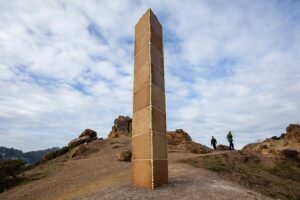
December 27: I…what????? Gingerbread monolith appears — then collapses — on San Francisco hilltop

In true pop-up-art fashion, a nearly 7-foot-tall monolith made of gingerbread mysteriously appeared on a San Francisco hilltop on Christmas Day and collapsed the next day.

A tower made of gingerbread squares on a patch of dirt on a hill. Boulders and hikers visible in the background.

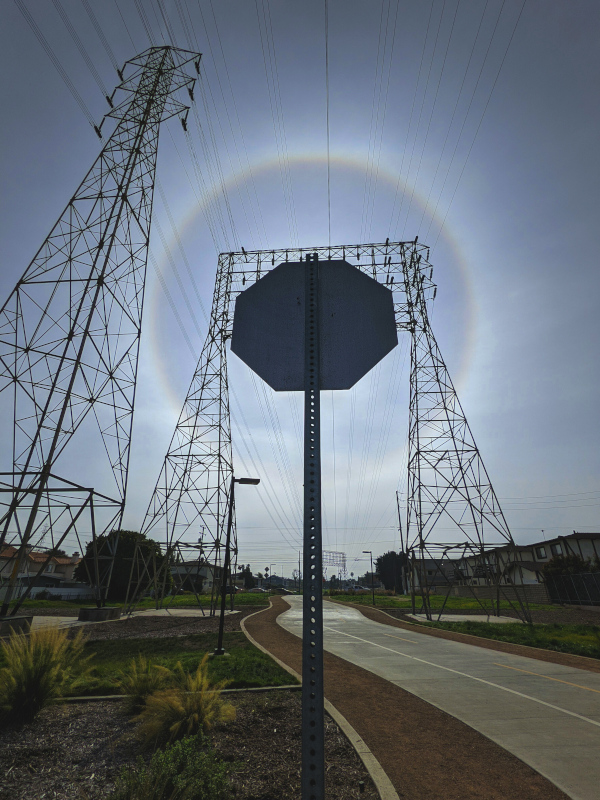
A bright circle in the sky surrounds the silhouette of a stop sign blocking the sun. Below it, a bike path winds into the distance and electrical towers stretch upward.

A bright circle in the sky surrounds the silhouette of a stop sign blocking the sun. Below it, a bike path winds into the distance and electrical towers stretch upward.

It turns out having a wide angle lens on your phone is really helpful for catching sun halos!

We watched Star Trek IV: The Voyage Home last night. It holds up better than I thought it would. At the end, I found myself trying to imagine the conversation between the whales and the probe. Probably something like this:

— Hey! We’re still here! Or, we’re back, anyway!
— Oh, good! What happened to you? We’ve been trying to reach you for ages.
— Apparently the humans killed us all.
— Wait, they did WHAT?
— Well, some of them did. But some of them brought us forward through time to make up for it. They won’t kill us now.
— They’d BETTER NOT!
— I think we’re OK now.
— *sigh* OK, good to know. We’ll go report back. Keep in touch.
— Thanks!

And I also imagined their reactions at the end, as they frolic in the 23rd-century ocean:

Wow! We’re in the open sea! And we talked to aliens! And the humans have stopped hunting us! And they’ve stopped polluting the oceans! This is AWESOME!

Well, except for the whole thing with us being the only humpback whales on the planet. But it’s not like we were really able to talk to much of anyone from the aquarium to begin with.

Seriously, though, it’s encouraging to know that, decades after the ban on hunting went into effect, the humpback whale population has rebounded so successfully that most populations are no longer threatened by extinction. I found articles citing a worldwide population of “over 80,000” and “just under 100,000” in 2016 — an order of magnitude more than the less-than-10,000 that were left in the 1980s!

»All pages site-wide with this tag