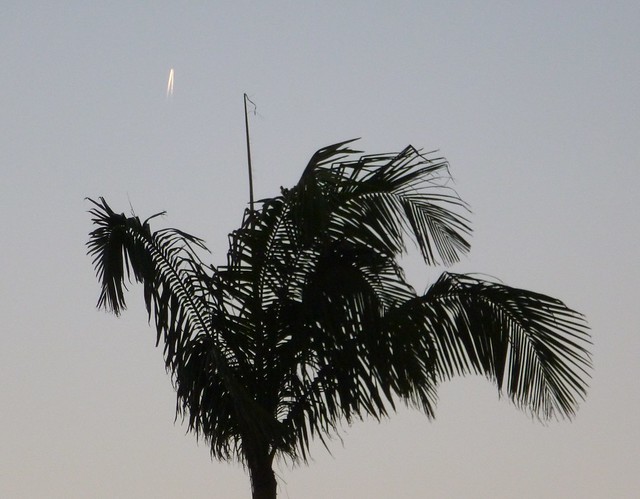
Remember about a year ago when people were all freaked out about a supposed missile launch off the coast of Los Angeles, even though there was no sign of it on radar and no one claimed responsibility? Remember how it turned out to just be an airplane contrail seen head-on so that it looked vertical? (Actually, I’d bet you probably didn’t hear that part, did you?)

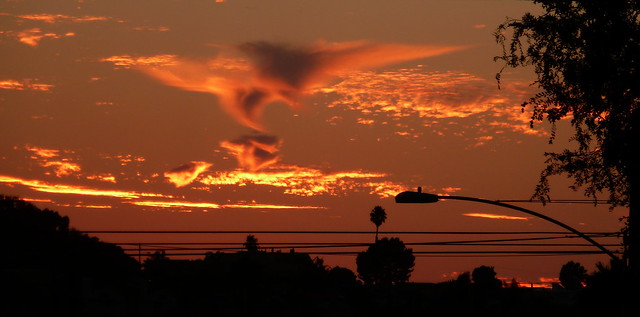
I was reminded of that when I saw this one today. Off the coast of Los Angeles again…pretty close to the airport.

Someone once asked me if my food allergies — the ones that require me to carry emergency medication so that I can keep breathing if I eat something with peanuts — could be all in my head. I pointed out that they can be diagnosed by a blood test, and asked how my head could influence the results of a test on a vial taken to a lab three states away.

ShareThis is rolling out a tool for “frictionless sharing.” That’s the term for those apps or widgets that “let” you broadcast everything you do on a site to your social network. I suppose it sounds great for publishers, because your content gets shared more, but…

As someone who reads stuff online, “Frictionless sharing” is a privacy disaster waiting to happen. Undo is nice, but in a world where updates are pushed instantly, you can’t count on it.

As someone who follows social networks, it’s just more noise. I don’t want to know every article you read in your latest wiki walk. I’ll tune it out, or I’ll tune you out. What I want to know is which articles, photos and videos you think are worth sharing.

Last year for the Fourth of July, we drove down to the Redondo Beach Pier to watch the fireworks being launched over the bay. It was a good display, but the logistics of getting out there and back was a major mess. We were already uncertain about how to handle it this year, and then J fell asleep the moment we got in the car (after refusing to nap all afternoon).

So this year we decided to just find a hillside and see what we could see. We stopped at the end of a residential street, where we could see a few other people out watching. We couldn’t see the local fireworks, but if we looked inland, we could see we could see distant fireworks displays all along the horizon.

On the other side of the very narrow block, the hillside drops sharply, offering a clear view south and east, and a slightly obstructed view to the west. (It’s the same area as where I went to watch the sun rise after a lunar eclipse last December.) There were a lot more people crowded there, all watching the local display. The low-level parts were hidden behind a hill, but the higher ones were clearly visible. I put J on my shoulders so he could watch — he probably doesn’t remember seeing fireworks before. Every once in a while I’d look off in the other direction to see what was visible in some neighboring city.

Seeing so many fireworks at once in the distance made for a very different experience than seeing one display up close. Not only was it stunning, but it drives home the point that this really is something all Americans celebrate together.

Allergies to nuts, grains, vegetables, seafood and milk are common. Allergies to meat? Much less so. But that’s starting to change.

A few months ago I read about adults (author John Grisham in particular) developing an allergy to red meat after being bitten by ticks.* And not just a low-level allergy like your face turning red — we’re talking full-on hives and anaphylactic** shock, the kind of thing that requires you to carry an Epi-Pen to make sure you keep breathing long enough to reach the emergency room.

Researchers have determined that the lone star tick’s bite can cause the body to produce an IgE antibody for a sugar called alpha-gal, which is found in mammal meat.

The result: from then on, you’re allergic to meat.

CNN calls it mysterious. Allergic Living calls it baffling. It’s certainly weird compared to “usual” allergies, and the fact that the reaction is usually delayed by a few hours makes it hard to diagnose, but we’re ahead of the game in understanding it: Unlike most allergies, we know what causes this one.

With most allergies, we know the process, but we don’t know what gets the ball rolling to begin with. We know that in people who are allergic to a food, exposure to it causes an IgE antibody reaction that triggers a massive release of histamines that sends the body into some level of shock, but we don’t know why some people have that reaction and others don’t.

There are a lot of ideas being investigated, with varying amounts of supporting evidence, but there’s still nothing we can point to and say: “This caused you to be allergic to nuts” or “That caused you to be allergic to milk.” Advice to parents concerned about keeping their child from developing allergies is all over the map.

2025 Update

When I posted this back in 2012, I segued into a call for fundraising for research. The particular fundraiser has since been discontinued, but research has dramatically improved both medical understanding and practical actions around allergies.

First: it’s been clearly demonstrated that early introduction of a food lowers the risk of a child developing an allergy to it. It’s not a guarantee, but at least there’s clear advice to parents now!

Plus, immunotherapy and IgE-targeting treatments can reduce sensitivity and severity (though they can’t always eliminate reactions entirely) for those of us who already have severe allergies, those who develop allergies as adults, and the (much smaller!) percentage of children who still develop food allergies even with early exposure.

Unfortunately there’s still no clear explanation for why that ~3% of children who do have early exposure still go on to develop allergies — or why some people bitten by the lone star tick develop what is now called alpha-gal syndrome and others don’t.

Advice these days is basically: Try not to get bitten by ticks, and if you do develop the allergy, stop eating red meat.

Notes

*Naturally, this was a few days after I hiked a severely overgrown trail without taking precautions against ticks, so I freaked out a bit, but I also hadn’t found any ticks when I got home from the hike.

**Fun fact: Chrome’s spell-checker doesn’t know “anaphylactic,” and suggested such helpful alternatives as “intergalactic” and “anticlimactic.” Not sure about the former, but I get the impression a lot of viewers suffered “anticlimactic shock” when watching the Lost finale.

ยปAll pages site-wide with this tag