A word to the wise for anyone planning to set up paperless billing: make sure the notices go to the right email address.

Last night, while paying bills, I realized I hadn’t seen a bill for our internet access in quite a while, and noticed that my bank showed the last payment had been sent in June. That didn’t look promising.

I logged onto the U-Verse website, and sure enough, our account was set for paperless billing. I hadn’t gotten the bills because they were being sent to an AT&T address which had been created as part of the setup process, but which I’d never used. So I paid the overdue bill, set up auto-pay so I wouldn’t have to worry about it again, and then set about making sure I’d actually get the statements. I thought about changing the address listed on the U-Verse profile, or forwarding it to my regular address, but settled on just setting up POP access to the account.

The weird thing is, I’m not entirely sure how we ended up with paperless billing. My filing system’s a mess right now, but I distinctly remember getting one bill on paper. (We signed up in May, as soon as we moved in.) I can’t have marked a checkbox on the bill, though, because I paid it through my bank’s website, not by check. My best guess is that I chose it during the setup process and forgot, and they just sent the first bill on paper.
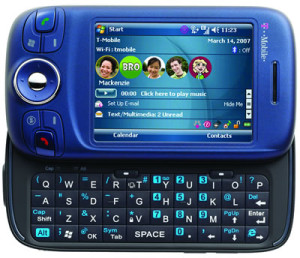
I mentioned a few weeks ago that I want some sort of mobile internet access for San Diego Comic-Con so that I can post at least some stuff from the convention itself, instead of waiting until I get back to the hotel. Since the con has never offered wi-fi (except, IIRC, in the press room — which I just realized I could have used last year, since I got a press badge for CBR/Comics Should Be Good), I was looking into phone-based solutions.

Phoning it In

I experimented with post-by-email (not sufficient), with post-through-Flickr (slightly better, but only really suitable for image posts and still missing things like, oh, titles), and with using WPhone to provide a stripped-down admin interface in the hopes that my phone’s built-in browser could handle it (no such luck). No, I was clearly going to need a better web browser — one way or another.

Yesterday I went into a T-Mobile store, partly to look at the smartphones they had, and partly to ask about what data plan would allow me to use Opera Mini on my current phone. The guy tried to sell me a Blackberry, but I have to admit the Wing looked really nice, if expensive.

Opera Mini - The free Web browser for nearly any phoneI asked about getting the Internet plan, and while the sales clerk was familiar with Opera Mini (he uses it on his own Blackberry), he was convinced it wouldn’t run on my RAZR V3t. I’d used an early version of it during a brief window in which T-Mobile allowed access even for phones with the T-Zones plan.  But he seemed convinced there would be no point, so I walked out without having changed anything.  30 seconds of Internet searching reveals that yes, Opera Mini is in fact known to work on the RAZR V3t.

Free WiFi

Today, the news started making the rounds that the con will have free wi-fi everywhere except the exhibit hall itself, sponsored by the film, Eagle Eye. (Which, now that I think about it, is oddly appropriate and somewhat disturbing.)   This is a huge relief, and makes the phone access much less critical. Though it would still be nice…

Sure, it’s going to be a very busy network. But I figure I’ll type things up in TextWrangler and load up the web just long enough to post. Gears will cut down on the amount of bandwidth needed for the admin interface.  And I’ll save any serious emailing or forum visits for the hotel room.  Actually, I’ll probably stay off the forums during most of the con, unless I have the opportunity to post “Hey, look what I just found out!”

At lunch today, I saw a woman, probably in her 50s, wearing a fitted black T-shirt that said, in sparkly letters, “BOTOX”. Srsly. I couldn’t find any pictures of the design, but a commenter here says it’s a promo handed out to staff at plastic surgery clinics.

Comic-Con has completely sold out. Hmm, let me rephrase that. There are no more memberships available for this year’s Comic-Con International in San Diego.

Spam Karma has gone GPL — After years of support Dr. Dave has decided to stop maintaining his spam plugin and turn it over to the open-source community. The project is now on Google Code. Update 2015: And now it’s on GitHub.

I went by the Spectrum for lunch, and the line to get into the Apple Store for the new iPhone was still stretched past several storefronts into the nearest courtyard, right up to the fountain by the carousel — even though they’d launched that morning. Actually, I had several co-workers who were late today because they went down at opening for the launch.

From what I hear it was fairly chaotic, at least in the morning. Apple’s new policy of making you activate the phone in the store was causing delays, especially factoring in the fact that iTunes’ servers got swamped. That would explain why the line was still so long several hours after opening.

Usability note: One of said co-workers got tripped up trying to sync music to his new phone, because the default is to not synchronize music, and the “Sync only checked songs” box looked close enough to being the right option that he didn’t dig deeper.

Sorry for the lack of updates this past week. I was just way too busy prepping for our move this weekend.

A couple of interesting news bits I noticed when I got into work this morning:

It looks like I’ve been lucky with installing Windows XP Service Pack 3. I’ve had no problems with the one machine I installed it on. According to Information Week, a lot of people are having serious problems with SP3, including BSOD on AMD-based systems.

Also, NetCraft has a screenshot of a PayPal page with both the green bar of an Extended Validation (EV) SSL certificate and a cross-site scripting (XSS) vulnerability. It’s a step or two beyond the standard lock icon, but there are still limits to what an EV cert can tell you. Unfortunately PayPal and others are really trying to drum “green bar = safe” into people’s heads.

It’s clear that a lot of people don’t actually read web pages before they respond to them. They’ll do things like…

  • Contact someone with a similar name, even when it’s clearly the wrong sort of organization — say, a student writing club and not the bookseller that’s been causing them problems.
  • Ask a blogger for a job application for a company mentioned in the post.
  • Ask unrelated tech support questions on a blog post because they used the wrong search terms for their problem.
  • Ask for help creating Flash animations on a forum dedicated to the Flash super-hero, then get indignant when people have the gall to point out that they’re in the wrong place.

Now, usability guru Jakob Nielsen reports on a study showing just how much people don’t read. In the average visit, users only read 28% of your text if you’re lucky. You have to drop way down — to 111 words — just to count on visitors reading half of it.

Depressing, but it explains so much. And it suggests there’s a benefit to highlighting key phrases. If they’re only going to read ¼ of the text, you may as well make sure it includes the important stuff.

Mark Pilgrim, in The Day the Music Died, points out what happens when DRM meets market failure.

On August 31, Microsoft will turn off the servers that validate their “PlaysForSure” DRM system (this predates the system they use for the Zune). This means that anyone who has bought music that uses PlaysForSure will not be able to transfer it when they upgrade or replace their computer, or get a new music player.

It won’t be an instantaneous death like DIVX was, or like a subscription system, because it doesn’t phone home whenever you try to play a track. But it’ll be a lot faster than simple technological obsolescence. I can still play my old VHS tapes until my VCR breaks down (and then I could probably still get it fixed if I really wanted to), even though I don’t think I’ve seen a pre-recorded tape in a store in years.

This is also why I prefer to check Amazon’s MP3 store first, before going onto the iTunes Music Store, and then prefer DRM-free iTunes Plus to standard iTunes tracks. Given their current position, Apple isn’t likely to get rid of iTunes anytime soon, but if they ever did, I’d be in the same boat as people who purchased PlaysForSure tracks. (Though I’m hoping they’ll move the entire catalog away from DRM long before that happens.) Whereas since Amazon’s tracks are plain, ordinary MP3s, they could abandon the business tomorrow and I’d still be able to play the tracks for as long as I can find software that plays MP3s.

(via ma.tt)

»All pages site-wide with this tag