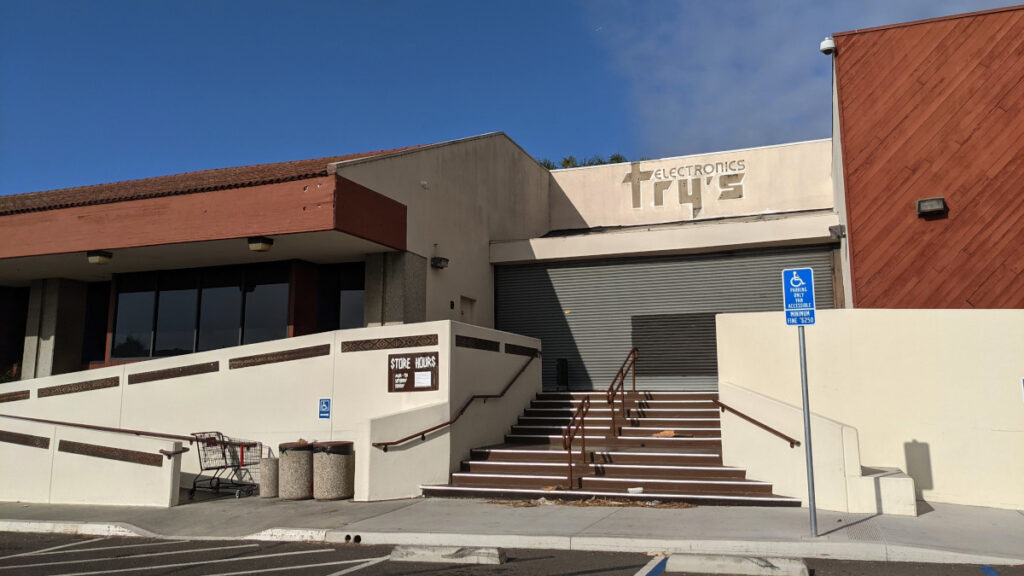
I’m going to miss two things about Fry’s Electronics, which shut down this week:
- Being able to walk in and grab random parts immediately.
- The decor.
And yeah, there’s nostalgia for the old days, but they’re already gone.
Back in the 1990s and early 2000s they really were a one-stop shop for computers, software, appliances, all kinds of electronics hardware, and the random snacks you might want to munch on while tinkering or upgrading. You could check out, or better yet try out – they had a huge number of computers available for demos – all kinds of cool tech.
I bought a lot of components for my desktop PC over the years, replacing pieces bit by bit. Sure, you could get complete systems at Micro Center or Best Buy or Circuit City, but none of them had the long tail of components that Fry’s did.
(There was also the generous return policy — I knew a lot of people who used the “Fry’s rental” when they needed something for a single project.)
Service was a mixed bag, though. Sometimes you’d get someone really knowledgeable who could help you pick out the best hardware combination for what you wanted. Sometimes you wouldn’t be able to find anyone. And a lot of the sales staff tended to be proto-techbros, so if you were shopping while female, or looking for Apple products — or worse, both — there was a good chance you’d get someone overly condescending.
Fading Away
They’ve been going downhill for a while. They dropped a lot of the middle range and focused on the high-end and low-end markets. All the articles talk about competition from online stores, and I suspect friendlier brick-and-mortar stores like Best Buy took over a lot of the mid-range consumer market.
When I built a gaming PC a few years ago, I tried Fry’s first, but I couldn’t find most of the parts I wanted. I only bought the case and power supply there, then ordered other parts from NewEgg, Amazon, or direct from the manufacturers. And I went back to Fry’s when I tried to put everything together and discovered I had the wrong mounting rails and needed another case fan.
They never really adapted to online shopping. Their website is still terrible (or was until Wednesday). Before 2019, big deal, I’d just walk into the store and browse anyway. But in 2020, after Covid-19 hit and in-person retail shut down, curbside pickup and shipping were the way to go. The search results were a pain to sort through, even for products that didn’t have nationwide shortages (like webcams). Even when I told it I wanted to look for shipping or local pickup, it kept trying to send me to San Jose, hundreds of miles away.
The Fry’s Experience
Ultimately, though, the most memorable thing about Fry’s couldn’t translate to a website. The locations I’ve been to were all converted warehouses or small office buildings. And each one was decorated with a theme.
Burbank’s store had a flying saucer crashed into the front, with statues of 50’s sci-fi aliens with ray guns scattered around as if they were invading the building. A giant squid’s tentacles supported the computer demo tables.
Anaheim had a giant mock-up of the Space Shuttle. If I remember right, the audio demo room was inside it.
Manhattan Beach had a Pacific Islands theme, with tropical plants, tiki statues, and murals based on Gauguin’s paintings from Tahiti.
Fountain Valley’s store was decked out in a classical Roman style, with columns, a mural of Roman gods, and a broken aqueduct that poured into a fountain in the center of the store. (I always thought that was a risky choice for an electronics store.)
Las Vegas had a giant slot machine for an entrance, but nothing special inside that I can recall.
Sad to say, I don’t seem to have taken photos inside any of these locations, though I do have a shot of the Vegas entryway, and of course now I can’t.
Update: I did get this shot of the former Manhattan Beach location a month after they closed.