Internet ExplorerInstalled the first Internet Explorer 8 beta. Some thoughts:

I’m impressed that it can import settings from Firefox & Safari.

It detected Firefox extensions and even offered to look up similar add-ons. Unfortunately it was a big long search string with all the titles, and therefore a useless list of results for things like cameras (yeah, how am I supposed to install a $1000 Nikon D80 on my web browser?) and the hint book for Splinter Cell.

Activities: My first thought was, “hey, they’re doing stuff with microformats!” Which is key to the underlying support (recognizing types of data and only offering relevant services, like maps for locations but not for book titles). But on the face of it, it’s a lot more like the way Flock integrates with various web services: Set up your blogging provider, and you can easily send stuff to your blog. Though right now they mostly have Microsoft-hosted services.

“Emulate IE7” appears to involve restarting in an alternate mode right now. I assume automatic switching is something planned for later betas.

Other than that, the UI seems about the same as IE7 so far.

It does indeed pass Acid2 (assuming the page isn’t swamped when you try to load it).

So, how else does its rendering differ?

Minor visual glitch: I have CSS-based banners on some pages (W3C validation, for instance), using spans with borders. If it’s on the last line of a page, IE will cut off the bottom border, because it extends past the end of the page. Other browsers show it. I’ve gotten around this in the past by adding a blank paragraph afterward, but now IE8 collapses the empty paragraph. That’s probably the correct thing to do, but it does mean adjusting things a bit. Not a big problem, though, because I’ve just noticed that it handles other pages fine, without the <p></p> workaround, which means that I’m probably already using a better solution elsewhere.

Several cases of re-styling UL lists seem to confuse it. The tabs running across the top of my Flash page, for instance, or the sidebar on the Alternative Browser Alliance. Others appear just as they do in other browsers (including IE7). This will bear investigation. (Edit: 2 different problems; see below.)

Still no sign of generated content. Beta 2? Please? Edit: according to CSS3.info, it does support generated content, but images don’t work (yet?). I’d been using this, progressive-enhancement–style, to add icons for outgoing links on my Flash site. It works in, well, everything else current.

Additionally: I’m surprised to see it so early, and to see it as a public beta and not something that required an MSDN login. And they had the sense to release a version for Windows XP! I was half-expecting it to be a Vista-only release, which would’ve been seriously annoying.

Further updates will be added below as I think of them.

It turns out the problem on the Alternative Browser Alliance menu wasn’t related to lists as I’d thought, but to a change in the CSS parser. For whatever reason, IE8b1 is susceptible to the Caio Hack (/*/*/ place code here /* comment */) normally used to hide CSS rules from Netscape 4. At this stage I should probably be able to remove it and not worry about NS4 anymore. (And it turns out that since I added media types to the link a while back, NS4 doesn’t even read the stylesheet in the first place!)

On the issue with the tabs on the Flash site, it looks like IE8b1 isn’t extending backgrounds beyond the text line on inline elements (oddly, also like NS4). This is probably what’s really going on with the CSS buttons I mentioned above. I’ll have to check which behavior is correct, but my money would be on the Gecko, Opera and WebKit interpretation. If so, this will probably be changed before the final release. If not, I’ll use inline-block instead. Which perhaps I should be doing anyway, except for the annoying fact that Firefox 2 doesn’t support inline-block and Firefox 3, which does, is still in beta.

I’ve reported the Caio Hack issue to Microsoft using their “Report a Webpage Problem” tool. The form emphasizes that you shouldn’t send anything that could identify you, so instead of reporting the problem on one of my own sites, I sent the page describing the hack. This probably means I reported it in the wrong way. 😕

It looks like Activities isn’t actually context-sensitive yet, since it’s offering to show me a map even when I’ve selected random prose instead of an address.

Having messed with it more than I probably should over the last 24 hours, I’ve come to a decision: During beta 1, any rendering problem I encounter in IE8b1 that works the way I want it to in Gecko, Opera, Safari and IE7, I’m going to assume is a bug in beta 1. I’ll try to narrow them down & report them when I have a chance, but I won’t actually change my sites’ code (except for retargeting IE-specific workarounds) until at least beta 2.
I’ve been meaning to post these photos for a while now, but with the discussion on Netscape’s impending doom, I should post them now.

Back in February, I was wandering the aisles at Micro Center and noticed a couple of odd software titles on the shelf:

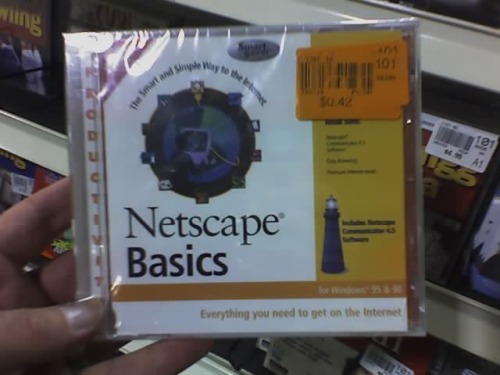
  • Netscape Basics, a jewel-cased CD-ROM which contained Netscape Communicator 4.5 and boasted compatibility with Windows 95 and Windows 98.
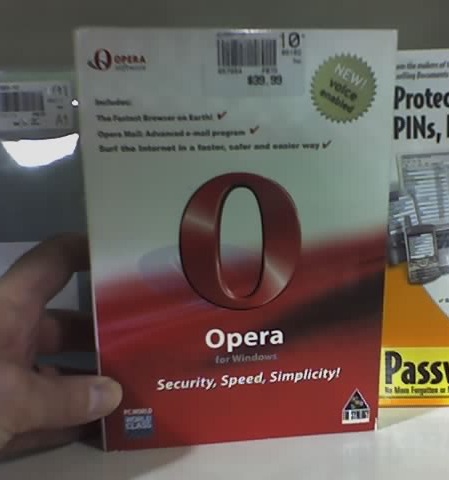
  • Opera for Windows, a boxed copy of I forget-which-version, but judging by the “New! Voice Enabled!” badge, it’s probably 8.0.

Keep in mind that this was February 2007. So that was an 8-year old Netscape box, and a 2-year-old Opera box. Netscape had been free for 9 years, and Opera had been free for 1½ years.

Someone had sensibly marked the Netscape CD down repeatedly, ending with a price tag of $0.42. I was half-tempted to buy it just to prove that I’d found it, but decided taking a picture would be better, since it wouldn’t clutter up my desk. Incredibly, no one had thought to mark down the Opera box. They were still asking $39.99 for it.

Did I mention pictures?

Netscape Basics CD for $0.42 Opera for Windows for… $39.99

NetscapeIt’s been a long time coming, but AOL has officially decided to shut down the Netscape web browser. The final security updates for Netscape 9 will go out in February, and then that’s it.

It’s been on life support for a while now, as AOL has tried repeatedly to revive it. After they dismantled the Netscape team in 2003 (just before spinning off the Mozilla Foundation), everyone expected that would be the end, but they came back with a surprise update, Netscape 7.2, the following year. Then they hired an outside company to reinvent it as a mash-up of Firefox and Internet Explorer, producing the Netscape 8 chimera. And just a few months ago, they went back to the well and released the Firefox-based Netscape 9, trying for the Flock model of integration with social networking sites…but only integrating with their own.

So what killed it? Netscape was arguably the pioneer, building on Mosaic’s success to create the first widely-used browser on the fledgling World Wide Web.

  • Internet Explorer being pre-installed on every Windows desktop
  • The commercial-to-freeware transition. Back in the 1990s, the only business model for giving away a free web browser was to subsidise it with revenue from other products. This led to selling the company to AOL, and opening the source code.
  • The missing Netscape 5. IE5 was considerably better than IE4, and arguably better than Netscape 4 in some areas. And Netscape didn’t have a new version to compete, because…
  • The transition to open-source took a lot longer than expected, leading to…
  • The disastrous Netscape 6. While there’s something to be said for meeting deadlines, Netscape 6 was a prime example of why not to release early. The program just wasn’t ready (Mozilla actually declared the code to be 0.6), and it turned off many users who might otherwise have stuck around a little longer for a stable release.
  • Fundamentally, though, AOL never seemed to know what to do with it. Is it a product? An exploitable brand name? A threat to brandish during contract negotiations with Microsoft?

FirefoxIt’s interesting that, as I made this list, I realized that the transition to open source really didn’t help Netscape, the company. But it led to the formation of the Mozilla Foundation and the release of Firefox, one of the most visible open source success stories out there. The company and brand name withered, but the code itself flourished.

Like the demise of IE/Mac, it’s more of a symbolic end than one of substance. In my opinion, the true “heir” so to speak of the early Netscape has been Mozilla, and now Firefox, for quite some time.

Update: Asa Dotzler has a somewhat less nostalgic take on the matter, as well as a link to commentary at TechCrunch. I can’t believe I forgot to mention the crippling/crufting of Netscape 6-7 as compared to Mozilla.

Update 2: More comments at Slashdot. Gee, I wonder who submitted that story? 😉

Update 3: Some commentary from the Web Standards Project, with a somewhat familiar-looking title.

(via Opera Watch)

Organization for Transformative Works – dedicated to protecting the expression of fan fiction, fan art, etc. (via Naomi Novik)

Open Standards, One Web, and Opera – Just why are standards important, anyway? (via Opera Watch)

Speaking of Opera, their EU antitrust complaint against Microsoft has been making waves. Responses at CSS3.info, Web Standards Project, Slashdot (edit: more Slashdot), Asa Dotzler, Opera Watch, plus a Q&A w/ Haarvard. My take: Good luck on unbundling, but if they can force Microsoft to catch up with the rest of the market in terms of standards support, I’m all for it.

Nissan vs. Nissan. On my way to work I saw a bumper sticker on an XTerra that said “In support of our freedom, it’s my last Nissan.” Huh? There was clearly a web address below it, but it was too small to read at that distance. So I looked up the phrase, and apparently there’s been a long-running dispute over the domain name nissan.com, between a small computer business named after its founder, Uzi Nissan, and the Nissan car company. The dispute was eventually resolved (correctly, IMO, since he has a legit reason to use the name) in favor of the little guy. On the other hand, I don’t see why the site makes such a big deal about Nissan’s “French Connection” to Renault.

Five years ago, Mozilla was forced to rename the Phoenix web browser because Phoenix Technologies was working on an in-BIOS browser that would let you get on the internet and troubleshoot/download drivers/etc. even if your operating system was trashed. It became Firebird, and then Firefox. The Phoenix product has finally been released. Ironically, it’s evolved into an embedded Linux distro that runs…Firefox.

Internet Explorer.Microsoft’s Internet Explorer Team reports on a new IE installer release. They’ve changed a couple of defaults, updated their tutorials… and dropped the requirement for Windows Genuine Advantage validation:

Because Microsoft takes its commitment to help protect the entire Windows ecosystem seriously, we’re updating the IE7 installation experience to make it available as broadly as possible to all Windows users. With today’s “Installation and Availability Update,” Internet Explorer 7 installation will no longer require Windows Genuine Advantage validation and will be available to all Windows XP users.

As much as I prefer alternatives like Firefox and Opera, I’ve been frustrated at the relatively slow uptake of IE7. It’s just insane that 6 years after its release, we’re still stuck designing for IE6 as the world’s most-used browser.

So who’s still running IE6?

  1. People running older versions of Windows that can’t run IE7, and who haven’t switched to something else. (This is a pretty small percentage, judging by OS stats.)
  2. People who don’t know how to upgrade to IE7, or why they should.
  3. People who actually want to stay with IE6 (whether for technical reasons or just stubbornness)
  4. People who would be happy to upgrade to IE7, except they can’t/won’t run WGA (on principle, or because it’s broken on their system, or because their OS is pirated).

I don’t know how big each group is, but Microsoft seems to think it’s worth going after #4.

It’ll be interesting to see whether there’s a jump in IE7’s marketshare relative to IE6. Maybe we’ll reach that next milestone sooner than I expected.

»All pages site-wide with this tag