
Note to self: in flame wars—excuse me, discussions—avoid using phrases like “No one is suggesting X” when dealing with straw man arguments. Because some jackass is guaranteed to suggest X.
Author Archives: Kelson

Clouds on the Horizon
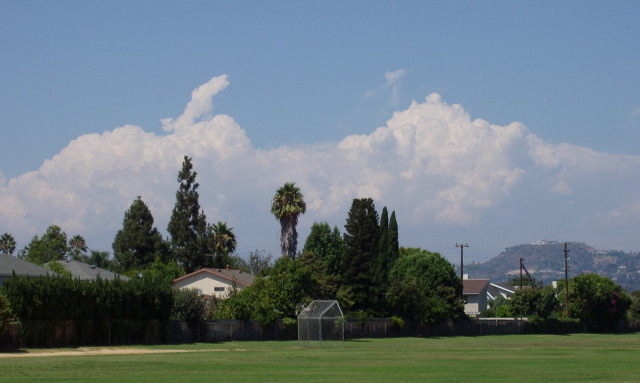
Well, June Gloom seems to be over, and we’re now into the time of year when we get hot, sunny days with lots of clouds. Big, towering cumulus clouds, often with anvil heads, promising shade and rain to cool things down. The teases.
Yeah, we see those clouds most afternoons—on the horizon, just on the other side of the coastal mountains!
While it’s great for summer activities—beach trips, swimming, hiking, etc.—it can also be frustrating when you have to choose between running your electricity-guzzling air conditioner all day or leaving your window open all night. The clouds are right there, taunting you with relief from the heat—relief that will not come.
When I was in high school, my family took a vacation across the Great American SouthwestTM. We went to Bryce Canyon, Zion Canyon, and the Grand Canyon. We drove out to Mesa Verde, which wasn’t a canyon, but there were still a lot of cliffs. We came back through Arizona, where we stopped by Meteor Crater and Sunset Crater. We joked that it was a tour of all the big holes in the ground. (A few years later, I posted some photos from this trip online.)
The weird thing about it was that we went during August, and we got rained on at least briefly almost every afternoon—but only outside of California. Utah? Rain. Arizona? Rain. Colorado? Rain. I don’t think we got rained on during our three hours in Nevada (we stopped at Valley of Fire on the way out), but as I recall, the rain stopped about the time we crossed from Arizona back into California.
We don’t get summer storms much here in SoCal.
Chaos in a Bag
At the market today, we discovered that you can buy a bag of Chaos. Not only that, but you can buy a bag of wheat-free Chaos.

In actuality it’s a brand of chips from the makers of Pirate’s Booty, but the name reminded us both of a time we and a bunch of friends started coming up with lists of product names based on abstract concepts. It started with a pun, “Diet Spite,” and eventually filled an entire sheet of paper. I think Jason ended up with the sheet, and may even have HTMLized it, but from there it fades into legend.
Mission Statements are utter BS
The member benefits section in the latest Golden Key newsletter features an announcement of a business partnership. Take a look at the first paragraph and see if you can figure out what the company does:
Owens Corning is a company with an unwavering commitment to delivering solutions, transforming markets and enhancing lives. It’s who we are. It’s why we are here. We do it by fully engaging our employees in support of growing our customer’s businesses. And when we do, we grow ours as well.
The second paragraph explains that they manufacture building supplies and provide construction services. The third contains a brief summary of the company’s history.
Now, tell me, what that hell is the point of the first paragraph? As best as I can tell its purpose is to make readers tune out before they actually get to the informative stuff.
Good-bye Global Frequency
Last year, a pilot was made for a TV show based on Warren Ellis’ Global Frequency, a series of one-shot stories about a worldwide organization of on-call specialists who take down threats to humanity. JMS would have been involved if it had been picked up. It didn’t make it to the air, though it was shopped around. And a few months ago, the pilot was leaked onto the internet, becoming wildly popular. This morning, Ellis posted the following remark in his email newsletter, Bad Signal:
It’s my current understanding that the bittorrenting of GLOBAL FREQUENCY has rendered it as dead as dead can get as a TV series. It seems that people in high places did not take kindly to the leak. I have no further details, so don’t ask.
Nice going, guys.
Sure, you can put the immediate blame on the suits who didn’t like being proved wrong about the show’s appeal… but it also reminds me of when the creators of Battlestar Galactica practically begged their fans to wait a few weeks and watch it on TV instead of downloading it off the net so that they’d get high enough ratings to be renewed.
For now, the only way to get Global Frequency remains the original, collected into two volumes: Planet Ablaze and Detonation Radio.
2026 Update: everyone’s phones are better than the Global Frequency phones were at the time, no TV or movie adaptation ever materialized beyond the pilot, and the comic is out of print (probably due to Ellis turning out to be a serial (and parallel) harasser). Barnes & Noble has an ebook edition for Nook, though.
Back in Space!
NASA Returns to Flight as Discovery Reaches Orbit.
Rather than getting my hopes up, I’ve been taking an “I’ll believe it when I see it” approach to this. And now, we’re finally back in space!
Here’s hoping the shuttle will be able to tide us over until the next-generation ship is ready. IMO we should have had another type of launch vehicle five years ago at the latest. That way Columbia never would have gone up, or if it had, we could have kept the newer fleet flying and just grounded the shuttles.
On a more personal note, I’m reminded of the time I went to see a shuttle landing. My mom took me and my brother out of school for a day, and we drove up with a family friend to Edwards Air Force Base where we set up camp with a zillion other people on the dry lake bed. We slept in the car, and the next morning everyone tried to get as close as possible to the chain link fence that marked the edge of the public viewing area.
Somewhere in a closet, I’ve still got a roll of slides from that landing. Of course, they had us so far away from the runway that I could barely catch the shuttle with a telephoto lens. I made an 8×10 print of the best slide in my grandfather’s home photo lab, and the shuttle was barely 1½ inches. [Update: I finally scanned the photos.]
And the shuttle that I watched land? It was Discovery, and it was the first flight since the Challenger disaster.
Now if someone can just convince NASA to give Hubble its 120-zillion mile checkup instead of just throwing it away…
Poorly Targeted Advertising
If you have a website, you’ve probably seen link swap spam. People running link farms search for a keyword or phrase, then fire off a zillion emails to the contact addresses about how they’ve looked at the site, their site is clearly relevant to yours, they’ve already linked to you and they want you to link back to their site.
All this without bothering to actually look at the sites in the search results.
For example: last Saturday I posted picture of the marquee in front of San Diego’s Ghirardelli Chocolate shop. By Monday someone had asked me to link to their website about chocolate, because our sites were clearly related.
Today I got one that trips the irony-meter. I’ve made four posts over the past year about targeted—or mistargeted—advertising. Just four. This morning I received three copies (one to my webmaster address and one to each DNS contact) of this message:
Hello,
I have found your website hyperborea.org by searching Google for “targeted advertising”. I think our websites has a similar theme, so I have already added your link to my website.