I saw an article about open space preservation efforts in Newport Beach, and decided to look up the area on maps’ satellite view. Looking around nearby areas in Newport, Laguna Beach, Irvine, Tustin, Orange, etc, I realized: the timeline of residential development in central Orange County is actually visible.

  • Newer neighborhoods have bigger houses than older ones.
  • Older neighborhoods have varied muted colored roofs. Newer ones are almost all red tile.
  • With some exceptions, older areas were built on flatter land & newer areas have crept into the hills, so grids are mostly older. The one newer area that’s flat-and-grid is all red tile roofs.

I don’t know how well it tracks for other areas. I’m less familiar with southern Orange County, for instance, and areas from Santa Ana northward into the LA Basin are much flatter and were largely built-up by the time I started paying attention.

Yahoo Groups is shutting down, taking years’ worth of users’ writing and discussions with it. It’s the latest reminder that if you don’t host it yourself, your stuff is at the mercy of someone else’s business decisions. Or whims.

And yet…

My old blog posts are full of dead links to sites where people were hosting their own stuff, but it’s gone now. I’m sure some was taken down deliberately, but I’m sure there’s also a lot that was lost because they couldn’t maintain it.

Self-hosting isn’t just a matter of knowledge. It’s a matter of time. It’s a matter of being able to update things that need to be changed (like TLS certs or software). And there are ongoing costs: Domain name registration. Hosting service, if you’re using a hosting provider. Bandwidth if you’re using your own server.

And if for some reason you can’t keep those ongoing costs going, guess what? Your stuff goes offline. But you’re still on Facebook!

There’s a character in Les Misérables, Pere Mabeuf, who gets left out of most adaptations. He’s an old man who, for a time, eked out a living from a book he’d published years earlier. Eventually he’s so strapped for cash that he has to sell the printing plates, so even if someone wanted to buy a print run, he couldn’t do it. Essentially, he was self-hosting his work until he couldn’t afford to anymore.

Imagine one of these scenarios:

  • You’ve got some nice photo gallery or CMS, and you can afford the storage and bandwidth…and then financial trouble hits.
  • You have a site for a hobby that you don’t keep up with anymore. You don’t mind leaving it online, but it gets to be a pain to keep going, and starts feeling like it’s not worth the effort.
  • You die, and your family has to decide how long to leave the FreedomBox plugged into the network.

On one hand, a social network site might close down like Google+, purge accounts like Tumblr, change pricing drastically like Flickr, lock down access like Instagram or Photobucket, change their algorithms for what people see like Facebook… On the other, you can keep using a service like Mastodon or Twitter or Facebook even if you lose the resources to maintain your software, your VPS, your internet connection that allows incoming HTTPS, etc.

The trade-off is not just convenience vs. control. It’s host your own stuff to protect it from the whims and misfortune of (and exploitation by) third-party services. Or use the cheap/free third-party services to protect your stuff from your own misfortune.

I still think, on balance, it’s better to host your own online presence if you can, at least the parts you want to be long-term. Have your conversations where other people are, and put your art or work somewhere you control. But as a backup, I think every CMS should incorporate an “Export to static site” feature*. That way, you (or your next of kin) can quickly produce a fully-functional static site to toss on cheap shared hosting as an archive.

*You can use wget -m in a pinch, but you probably also want to remove things like comment forms in the process.

Once upon a time, the idea that “only the code mattered” was sold as a way to be inclusive. No one would be shut out if their code was good.

But building software is more than code. It’s design. Planning. Discussion. It’s figuring out use cases, misuse cases, and failure modes. It’s interacting with people.

And if you allow some people to treat others like crap because only the code matters, you end up causing harm and driving people away.

Which obviously isn’t inclusive.

If you mistreat people or violate ethics to make your “technically perfect” software, those people have still been mistreated. Those ethics have still been violated. People have created marvels of engineering and fantastic art by abusing or exploiting others. People have done the same while abusing or exploiting people on the side. And people have created wonders while trying very hard not to abuse or exploit others.

The accomplishment doesn’t erase the exploitation or abuse. And if you can accomplish something incredible without mistreating others, it obviously doesn’t justify the mistreatment.

But the culture of “only the code matters” turned into a culture of tolerating assholes because they were good at their job. The ends justify the means. From trying to enhance freedom, to embracing Machiavelli.

It certainly didn’t help that 90s hacker culture had a significant BOFH element to it, with its built-in disdain for those with less technical knowledge. The Free part tended to prioritize programmers and sysadmins over “lusers.” It was Animal Farm with computer users. Sure, we tried to throw off the corporate overlords who were dictating how people could use their computers. But some computer users were more equal than others.

So a lot of people who could have become part of the Free Software community found a hostile environment and left in disgust. Or fear. And even if you don’t care about the harm done to them, consider their potential contributions. Free Software has always had a problem with coverage: Programmers work on problems that they find interesting or useful. The boring parts, the use cases that they personally don’t use, tend to fall by the wayside.

Yeah, your code is good…but the spec’s incomplete because you pushed away the people who would have pointed out a common use case, or just how easy it would be for a feature to be misused. You didn’t think they were worth listening to because they weren’t rockstar coders. But they also had information you didn’t.

Not that throwing off the corporate shackles has worked out all that well. Every platform now has its own walled garden. Microsoft is less dominant than it once was, but we have new mega-corps who’ve managed to leverage an internet built on Free/libre and open-source software into their own positions of dominance. And trying to maintain services for people who’ve come to expect free/gratis has brought us to the point where adware is the norm, and surveillance is everywhere…to better target those ads. And the majority of computing devices out there are locked down, preventing ordinary users from tinkering with them and developing that technical competence that might bring them into the fold…

If we’ll even let them join.

Tomato plant with a mix of red and green tomatoes, growing out of the side of a palm tree.

Is this the weirdest place I’ve seen a volunteer tomato? It’s certainly up there!

*sorry*

*ok, not sorry* ๐Ÿ™‚

Originally posted on Pixelfed. Observation on iNaturalist.

Update: There’s also a black nightshade of some sort and a ficus growing out of the same tree, which you can sort of see in the medium-zoom photo.

Update Sep 13: Found a notice pinned to all the trees along this edge of the block: The construction project for the LAX people-mover wants to take them all out.

They do intend to replace them, but I guess the treetop tomato is not long for this world. ๐Ÿ˜ข

Doom and gloom alone aren’t enough to help us deal with climate change, or any of the other problems we face. Fear sustained turns to despair, and to inaction – because why bother?

We have to celebrate successes to keep hope alive so we can keep going.

We do need to know what we’re up against. We need to understand how serious the stakes are. But we also have to believe that what we do will – or at least can – make a difference.

I keep thinking of Star Wars: The Last Jedi. The first time through was grueling, watching the relentless assault of the First Order as it tried to snuff out every last bit of hope. The scenes with Rey and Luke were a relief because he was “only” depressed, not doomed.

But Luke eventually regains enough hope to take action. And enough of the Resistance is able to survive, keeping the spark of hope alive. And their legend survives, passed from Rose and Finn to a stable boy on Canto Bight, who’s already fanning that spark.

The whole movie is about hope: whether you’ve lost it or someone is actively trying to stomp it out, as long as it exists, you can hold onto it. That hope that, to quote another trilogy, “There’s some good in this world, Mr. Frodo, and it’s worth fighting for.”

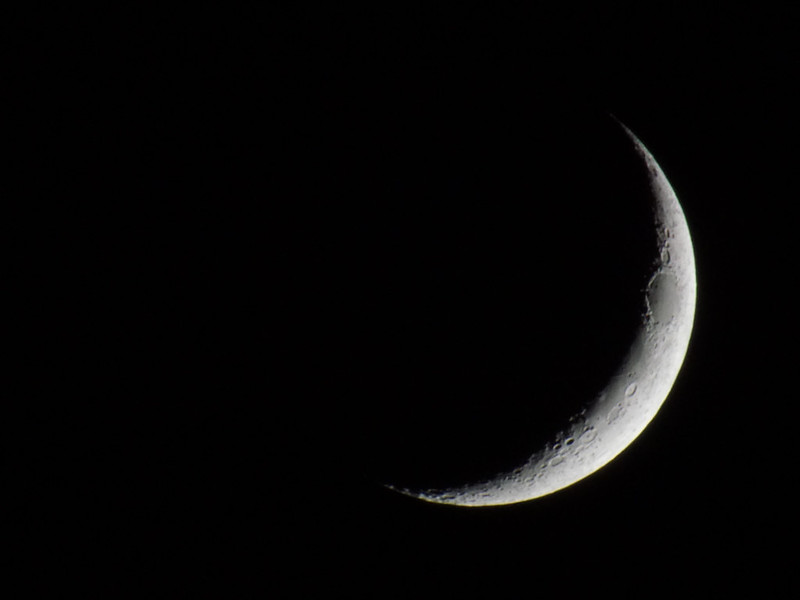
Crescent Moon.

Saturday night’s crescent moon. One shot for the daylit crescent, the other for the night side lit by earthshine (with some clouds as a bonus). J. helped with focusing the telephoto lens.

The second shot is a lot noisier than I’d like since I was adjusting levels on the JPEG, but I have the raw file, so maybe I’ll be able to do something better with it. It’ll be a good exercise in learning how to use Darktable.

Overexposed crescent moon, with the  night side faintly visible and a glowing cloud below it.

Cnet has a report on how police departments are being inundated with false alarms from Amazon Ring alerts because people have freaked out over the camera footage of innocent activities. In one case someone called to report footage of themselves walking into the door!

I’m reminded of a case that happened nearby just a month ago. In Manhattan Beach (near Los Angeles), police from five cities — and an LA Sheriff’s helicopter — descended on a neighborhood because someone panicked over Ring footage of a food delivery sent to the wrong address. It took them an hour and a half to confirm that there was no crime in progress.

The story basically filled a bingo card:

  • IoT doorbell camera (and of course it was Ring)
  • Gig/app delivery service
  • Upscale neighborhood
  • Paranoid reaction to, you know, people
  • NextDoor posts quoted in article (because of course they are)
  • Massive police over-response
  • SMS alerts sent to neighboring cities

It was absurd. Fortunately no one was hurt or arrested, so it remains an absurdity, but between the waste of resources, the increase in fear, and the risk that something could have gone wrong, it fits right in with these other cautionary tales. As Fight for the Future puts it:

Ubiquitous, privately owned surveillance camera networks are NOT going to make our neighborhoods safer. They just make us all paranoid. Soon we’ll be snitching on our neighbors Red Scare style. Enough

ยปAll pages site-wide with this tag