

Actually it’s just the last light of the setting sun reflecting off of a structure (the observatory?) atop Mt. Wilson. Also, you can see the sign on the Wilshire Grand tower is seriously bright, even from this far away.
Actually it’s just the last light of the setting sun reflecting off of a structure (the observatory?) atop Mt. Wilson. Also, you can see the sign on the Wilshire Grand tower is seriously bright, even from this far away.
The cold-war musical Chess works surprisingly well set in the present day.
 UCI Drama’s production is a concert staging of the show, with the orchestra and choir onstage, and the actors carrying handheld microphones with minimal props. It works well, especially for the more 80s-pop numbers like “Nobody’s Side” and the big ensemble songs like “Merano” and the chess games, though it gets a little awkward when the characters are singing to each other with microphones. (The show features two competing styles of music, achingly 80s and classical musical theater.)
The show’s structure is fluid, with vast differences between the original London and Broadway versions and later productions, and just about every version tweaking the story and moving songs around. This version largely follows the London stage version, with a few key changes:
The performances were all solid, with Molokova in particular as a standout.
An aside: I found it interesting to see an actual production of Chess at UCI, since the songs had been so popular with the musical theater crowd when I was there in the 1990s. “I Know Him So Well,” “Heaven Help My Heart,” and “Someone Else’s Story” were standards in the library, and I heard them a zillion times, while all the guys who were serious about musicals wanted to sing “Anthem.” And really, can you blame them?
I’m still not sure how well “Someone Else’s Story” works for Svetlana, but that ship has sailed. And “One Night In Bangkok,” despite being instantly recognizable to anyone who lived through the 80s, is cringe-worthy now. For this production they downplay the stereotyping by playing up the fact that it’s seen through the perspective of a total lout (Freddie). It’s still cringe-worthy, but at least it’s a character statement rather than a narrative one.
The production continues through this weekend.

At a tech training session, I wanted to get access to some of my class-related email on the training computer. But I didn’t want to log into my primary email on an open network, or on someone else’s computer at all. I have no idea what they’re logging, whether they’re doing SSL inspection, whether there’s a keylogger on it — probably not, but who knows?
Heck, I didn’t even want to use my own device on the hotel Wi-Fi without a VPN, and that was at least secured by WPA2! (then again…)
I ended up forwarding the extra class materials to a disposable email account and logging into that one. No risk to other accounts if it got sniffed, at any level.
But I remembered how we all used to get at email when traveling back in the early 2000s, before smartphones, and before every laptop and every Starbucks had Wi-Fi:
Internet Cafes.
We’d walk into a storefront and rent time on one of their computers. Then we’d go to our webmail site and type in our primary email login and password over plain, unsecured HTTP without TLS.
I’d never do that today. Admittedly, I wouldn’t need to in most cases — I can access my email wirelessly from a device I own that I carry in my pocket. (Whether that’s a good thing remains up for debate.)
But more importantly, we know how easy it is for someone to break into that sort of setup. Even if your own devices are clean, someone else’s computer might have malware or keyloggers or a bogus SSL cert authority on their browser to let them intercept HTTPS traffic. An HTTP website is wide open, no matter whose device you use. And an open network is easy to spoof.
So these days it’s defense in depth: If it needs a password, it had better be running on HTTPS. If I don’t trust the network, I use a VPN. And I really don’t want to enter my login info on somebody else’s device.
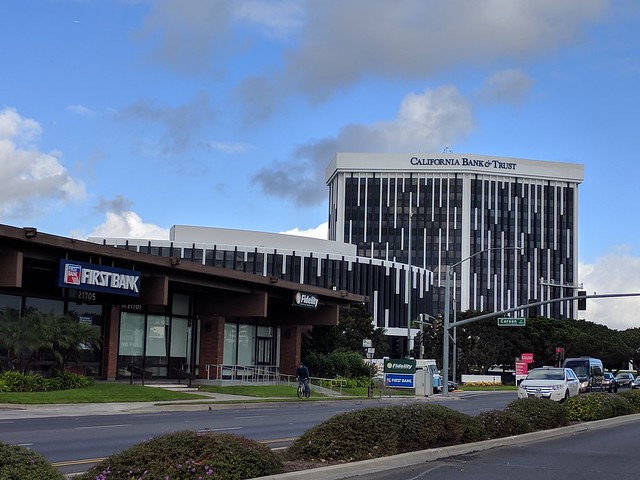
They’re in the process of adding another building to this office complex in Torrance. Meanwhile, they’ve cleaned up the existing buildings a bit, replacing the traditional stripe pattern of windows and narrow strips of wall with this broken-line pattern that actually looks interesting.
Originally posted on Instagram. When I imported it here, I decided to use the wider crop and description from Flickr.
If you are told a child in your care has a severe food allergy, believe them. Don’t kill a three-year-old with a grilled cheese sandwich.
According to his parents, staff at the preschool knew about his severe dairy allergy, but an adult gave him the cheese sandwich anyway. He ate it, went into anaphylactic shock, and died in the emergency room. No word on whether they gave him epinephrine. (New York law allows schools to stock it, but doesn’t require them to.) Update: Apparently the school called his mother instead of 911. Want to bet paramedics could have helped?
“We will get to the bottom of what happened here…” says a spokesman for NYC’s health department, “and whether the facility could have done something differently to prevent this tragedy.” Well, yeah: Don’t give kids food that you know they’re severely allergic to!
Children with severe allergies know to avoid certain foods, but they need help to do it:
Maybe it was someone new who didn’t know yet. Maybe it was someone who didn’t take it seriously. Maybe there was a mix-up and he was supposed to get something else, but they handed him the cheese sandwich by mistake. All of those could have been prevented.
Yes, mistakes happen. Even fatal ones. But they happen a lot less often when you listen to people who are facing the danger, believe them, and take action to follow through on it.
1 in 13 children has a food allergy. Even if your child doesn’t, they have friends who do.
Don’t let them down.
Update on the case from Allergic Living (Nov 16):
The incident is still under investigation. It’s not even clear at this point whether the specific person who gave him the sandwich was aware of the allergy (though they certainly should have been), or whether they gave him epinephrine, though it is clear that:
The school has been closed pending the investigation results, and new directives have been issued that childcare staff will call 911 in the event of a medical emergency.
Another update from Allergic Living (May 2018):
Things I think about when choosing where to post something original, once I’ve decided to post it.
So yeah, that’s why I still post some things here, why I only post other things on Twitter, why I post different things to Flickr and Instagram, why I sometimes cross-post, re-post, and re-edit. Am I overthinking it? Maybe, but it’s not like I go through a full checklist every time – this is less a recipe and more trying to write down what I’ve been doing anyway.
I’ve had the “Google Assistant” on my phone for a few weeks now. Since I don’t use the always-on voice activation, this means it’s pushing extra notifications based on what it thinks I want/can use. Fortunately it doesn’t do audio alerts, so it’s a lot less intrusive than it could be. I figured I’d give it a try and see if it turned out to be useful (or creepy).
The alerts I’ve gotten fall into the following categories:
At this point, I think the experiment has run its course. The only category that’s been consistently useful is the TV premiere schedule… and that only comes up a couple of times a year.